An English-speaking dentist is a dental professional who communicates fluently in English to deliver clear, culturally sensitive care to English-speaking patients. For expats and international travellers, this distinction is far more than a convenience. Patient satisfaction rates are nearly 40% higher when a dentist and patient share a primary language. That figure reflects something clinically significant: shared language is not just comfort, it is a safety mechanism. Clinics such as R&H Dental Marbella have built their entire model around this principle, assembling multilingual teams from Finland, New Zealand, Ireland, Portugal, and Spain to serve the international community on the Costa del Sol.
Why choose an English-speaking dentist: communication and patient safety
Language barriers in dental settings cause real clinical harm. Language barriers cause patients to downplay symptoms, which leads directly to misdiagnosis and treatment delays. A patient who cannot describe the precise location, character, or duration of pain is a patient whose dentist is working with incomplete information.
The gap between conversational English and clinical dental English is wider than most patients expect. Dentists trained in English dental terminology create a fundamentally different clinical encounter, one where terms like periapical abscess, occlusal adjustment, or osseointegration are explained in plain language rather than guessed at through gesture. This matters most during medical history taking, allergy disclosure, and informed consent, the three moments where miscommunication carries the highest risk.
Professional language-concordant care reduces medical errors and improves informed consent compared with third-party translators. A translator, however well-intentioned, introduces a third voice into a clinical conversation that should be direct and unambiguous. The dentist loses the ability to read hesitation, ask spontaneous follow-up questions, or reassure a nervous patient in real time.
- Medical history accuracy: Patients describe symptoms, medications, and allergies with full vocabulary, reducing the risk of dangerous omissions.
- Informed consent: Treatment options, risks, and alternatives are explained clearly, so patients can make genuinely informed decisions.
- Post-treatment instructions: Recovery guidance delivered in English is followed correctly, reducing complications.
- Emergency communication: If something goes wrong, a patient can describe it precisely and receive an accurate response immediately.
Pro Tip: Before booking, send the clinic a detailed question about a treatment you are considering. A grammatically clear, specific, and prompt reply is a reliable indicator of the English proficiency you will encounter in the chair.
English-speaking dental services in Marbella, Mexico City, and the Netherlands
The availability of English-speaking dental care varies considerably across popular expat destinations, and understanding those differences helps you make a better choice.
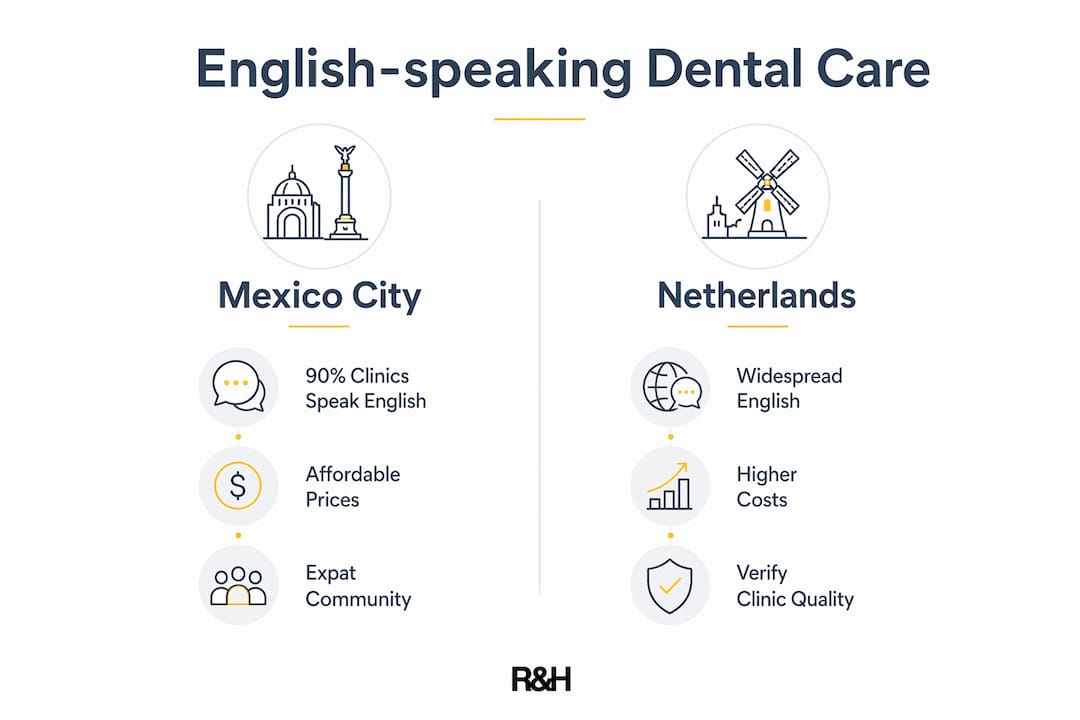
Over 90% of dental clinics in expat-friendly areas of Mexico City have English-speaking staff, often with dentists trained in the United States or Canada. That concentration reflects decades of cross-border patient flow and a dental education system that has adapted accordingly. The trade-off is variability in technology and facility standards, which makes independent vetting essential.
In the Netherlands, routine dental checkups cost between 25 and 40 EUR, and most practices speak English. However, verifying language capability before booking is still advised, because English fluency among reception staff does not always extend to the clinical team. Dutch dental care is well regulated, but expats report that clinical explanations can be brief and assumption-heavy when the dentist assumes the patient understands European dental norms.
| Destination | English availability | Typical checkup cost | Key consideration |
|---|---|---|---|
| Mexico City (expat zones) | 90%+ of clinics | Significantly below European rates | Verify technology and qualifications independently |
| Netherlands | Most practices | 25–40 EUR | Confirm clinical team speaks English, not just reception |
| Marbella, Spain | Specialist clinics | Transparent, published pricing | Seek clinics with international training and written guarantees |
Marbella occupies a distinct position in this comparison. The Costa del Sol has one of the largest English-speaking expat communities in Europe, and the dental market has responded with clinics that treat international patients as their primary audience rather than an afterthought. R&H Dental Marbella exemplifies this model: the team holds qualifications from multiple countries, uses 3D CBCT imaging and an in-house digital laboratory, and publishes its transparent pricing in Marbella so patients know costs before they arrive.
How does language concordance reduce dental anxiety?
Dental anxiety is one of the most common barriers to consistent oral health care, and language plays a direct role in it. Dental anxiety decreases significantly when patients can communicate and understand procedures in their native language. The mechanism is straightforward: uncertainty amplifies fear, and clear language removes uncertainty.
Cultural competence adds a second layer. Patients from the United Kingdom, Ireland, the United States, Australia, and South Africa carry different expectations about dental aesthetics, treatment pacing, and the dentist-patient relationship. A dentist who understands those expectations does not just speak English fluently. They understand what a British patient means when they say they want a “natural-looking” result, or what an American patient expects when they ask about a smile makeover. That cultural literacy shapes the entire treatment plan.
Patients who receive care in their primary language show better adherence to treatment plans and report less post-treatment pain. Adherence matters enormously in dentistry, where multi-stage treatments such as implants or orthodontics require patients to follow precise home care instructions over months.
The following steps help expats assess cultural and linguistic fit before committing to a clinic:
- Contact the clinic in writing and note whether the reply addresses your specific question or offers a generic response.
- Ask about your home-country dental norms during an initial consultation. A culturally competent dentist will engage with the comparison rather than dismiss it.
- Request that the dentist explain a procedure step by step before agreeing to it. Clarity at this stage predicts clarity throughout treatment.
- Observe the reception team. If the front desk cannot communicate confidently in English, clinical communication may be inconsistent too.
Pro Tip: Ask the clinic whether the entire team, including dental nurses and hygienists, speaks English. A dentist who is fluent but supported by non-English-speaking staff creates communication gaps at critical moments.
How to find and verify a trustworthy English-speaking dentist abroad
Finding an English-speaking dentist is straightforward in most expat hubs. Verifying that the clinic meets a high clinical standard requires more deliberate effort.
Initial contact via WhatsApp or email is one of the most reliable early tests of a clinic’s communication quality. A prompt, clear, and specific reply signals that the practice values and is capable of English-language communication at every stage of care. A slow, vague, or template-driven reply is a warning sign worth taking seriously.
Beyond the initial contact, use these criteria to vet any clinic you are considering:
- International qualifications: Check that dentists hold degrees or postgraduate training from recognised institutions. Clinics like R&H Dental Marbella employ dentists with 15–35 years of experience and training across multiple countries.
- Expat-specific reviews: Look for reviews written by English-speaking patients, not just star ratings. Detailed reviews reveal how well the clinic handles communication, pricing transparency, and follow-up care.
- Published pricing: Transparent, itemised pricing published on the clinic website removes the risk of unexpected costs and signals professional confidence.
- Technology: 3D CBCT imaging, digital X-rays, and in-house laboratories indicate a clinic that invests in diagnostic accuracy and treatment quality.
- Written guarantees: A clinic that offers a written guarantee on its work stands behind its outcomes. This is a meaningful differentiator in international dental care.
- Whole-team English fluency: Confirm that nurses, hygienists, and reception staff all communicate in English. This protects you at every touchpoint, not just during the clinical appointment.
Expatriate networks such as local Facebook groups, community forums, and relocation services are also valuable sources of first-hand recommendations. Patients who have already navigated the process of dental care for expat families in a given city will give you information that no clinic website can replicate.
Key takeaways
Choosing an English-speaking dentist is a clinical decision, not a preference: language concordance directly reduces diagnostic errors, improves informed consent, and lowers dental anxiety for expats and international travellers.
| Point | Details |
|---|---|
| Language concordance improves safety | Shared language reduces misdiagnosis risk and supports accurate medical history and allergy disclosure. |
| Satisfaction rises with shared language | Patient satisfaction rates are nearly 40% higher when dentist and patient communicate in the same language. |
| Whole-team fluency matters | English proficiency must extend to nurses, hygienists, and reception staff, not just the treating dentist. |
| Vetting starts before the appointment | A clear, prompt reply to an email or WhatsApp enquiry is a reliable indicator of clinical communication quality. |
| Marbella offers specialist expat care | Clinics such as R&H Dental Marbella combine multilingual teams, advanced technology, and transparent pricing for international patients. |
What we have learned from treating international patients
After years of working with expats and international travellers, the pattern is consistent. The patients who arrive most anxious are rarely anxious about the treatment itself. They are anxious about not being understood.
The misunderstandings we see most often are not dramatic. They are quiet ones: a patient who did not mention a medication because they did not know the English word for it; a patient who agreed to a treatment plan they did not fully follow because the post-treatment instructions were too complex to retain in a second language; a patient who delayed seeking care for months because they were not confident they could explain their symptoms clearly. Each of these situations is preventable with the right clinical environment.
Cultural sensitivity is equally important and often underestimated. British and Irish patients, in particular, tend to understate discomfort out of politeness. A dentist who understands that cultural tendency will ask more specific questions rather than accepting “it’s fine” at face value. That kind of attunement comes from experience with international patients, not just language fluency.
The role of English-speaking dentists in expat communities is, at its core, about removing the barriers that prevent people from getting the care they need. When a patient can describe their pain precisely, ask questions freely, and understand the answers they receive, the entire clinical relationship changes. Outcomes improve. Trust builds. Patients return.
We encourage every expat to treat language access as a non-negotiable criterion when choosing a dentist abroad, not a bonus feature.
— R&H Dentists
R&H Dental Marbella: English-speaking dental care on the Costa del Sol
R&H Dental Marbella brings together a multilingual team with 15–35 years of experience each, drawn from Finland, New Zealand, Ireland, Portugal, and Spain. Every dentist communicates fluently in English, and so does the wider clinical team.
The clinic uses 3D CBCT imaging and an in-house digital laboratory to support accurate diagnosis and high-quality restorations. All treatment costs are published in advance through transparent pricing, and every significant treatment is backed by a written guarantee. Whether you are considering a routine checkup, dental implants, or a full smile makeover, the team is available to answer your questions in plain English before you commit to anything. A virtual tour of the clinic is available online if you would like to see the facilities before booking.
FAQ
Why does language matter so much in dental care?
Language barriers cause patients to downplay symptoms, which leads to misdiagnosis and delayed treatment. Direct communication in a shared language is the safest and most effective model for dental care.
Is it enough if just the dentist speaks English?
No. Dental nurses, hygienists, and reception staff all interact with patients at critical moments. Whole-team English fluency protects communication throughout the entire visit, not only during the clinical appointment.
How do I verify a clinic’s English proficiency before booking?
Send a detailed question by email or WhatsApp and assess the reply. A clear, specific, and prompt response is a strong indicator of the communication standard you will experience in person.
Are English-speaking dentists more expensive?
Not necessarily. In Marbella, clinics such as R&H Dental Marbella publish transparent pricing that is competitive with other European destinations. The cost of miscommunication, including repeated treatments or delayed diagnosis, typically exceeds any premium for language-concordant care.
What should I ask at a first consultation with an English-speaking dentist?
Ask the dentist to explain your diagnosis and all treatment options in plain language. Ask about the qualifications of the clinical team, the technology used for diagnosis, and whether the clinic offers a written guarantee on its work.
.png)