Teeth whitening methods use either chemical bleaching agents or mechanical abrasion to reduce tooth discolouration and improve overall smile brightness. Chemical whitening relies on peroxide compounds, primarily hydrogen peroxide or carbamide peroxide, to penetrate enamel and break apart stain molecules. Mechanical whitening, by contrast, uses mild abrasives to polish surface stains without altering the underlying tooth colour. The two approaches differ significantly in depth of effect, speed, and suitability for different patients. Understanding which category a product belongs to is the first step in choosing the right option for your goals, your budget, and your dental health.
1. Professional in-office whitening
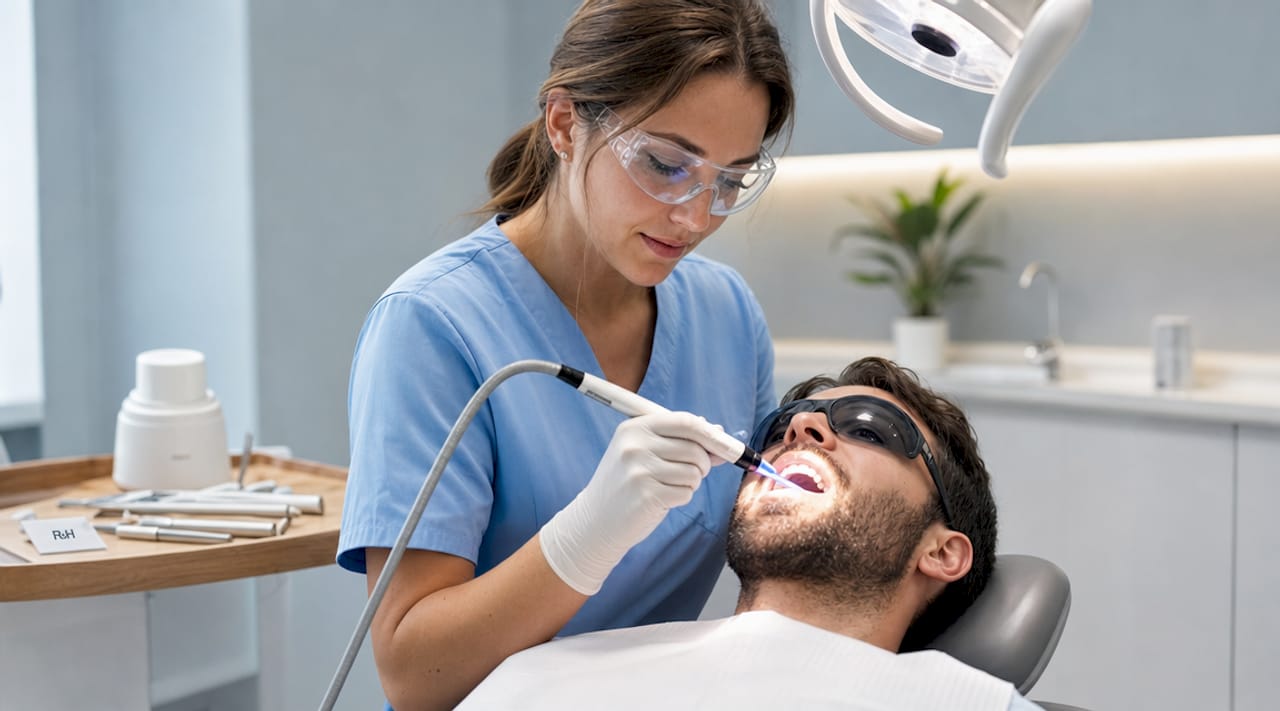
Professional in-office whitening is the most effective teeth whitening method available, delivering the fastest and most dramatic results under controlled clinical conditions. Treatments use high-concentration hydrogen peroxide gels, typically in the 35 to 40 percent range, applied directly to the teeth by a trained dentist. Protective gum barriers and careful monitoring throughout the session reduce the risk of soft tissue irritation and post-treatment sensitivity.
A 2026 clinical trial confirmed that single-application protocols using 35% hydrogen peroxide achieve whitening results comparable to multiple-application sessions, with no significant difference in sensitivity levels. This is clinically meaningful because it means shorter chair time does not compromise outcomes. Most patients can expect a shade improvement of six to ten levels in a single appointment.
Long-term results are also well documented. In-office bleaching agents with 35 to 40% hydrogen peroxide deliver stable colour improvement lasting up to 18 months, depending on formulation and individual lifestyle factors. The pH of the gel formulation influences regression rates, which is why product choice matters beyond concentration alone.
- Typical session duration: 60 to 90 minutes
- Shade improvement: 6 to 10 levels in one visit
- Colour stability: up to 18 months with appropriate maintenance
- Protective measures: gum barriers, desensitising agents, clinical monitoring
Pro Tip: Ask your dentist whether they use a desensitising agent before or after the bleaching gel. Pre-treatment with potassium nitrate or fluoride varnish measurably reduces post-procedure sensitivity, particularly for patients who already experience thermal sensitivity.
2. Dentist-supervised take-home trays
Dentist-supervised take-home whitening sits between professional in-office treatment and over-the-counter products in terms of both concentration and clinical oversight. The dentist takes impressions of your teeth and fabricates custom-fitted trays, which are then used at home with a prescribed carbamide peroxide gel, typically at concentrations between 10 and 22 percent.
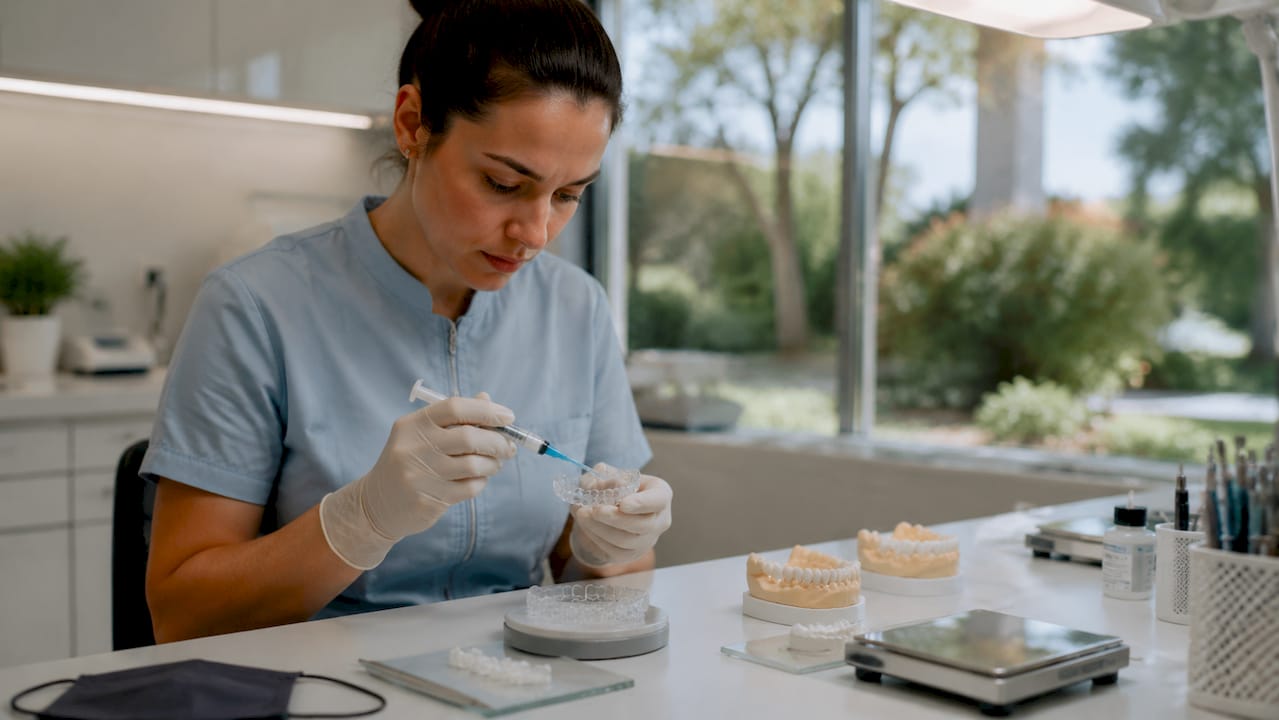
Carbamide peroxide in take-home trays releases hydrogen peroxide slowly during wear, with 10% carbamide peroxide roughly equivalent to 3.5% hydrogen peroxide in effect. This slower release is gentler on enamel and gum tissue, making it a practical choice for patients with mild to moderate sensitivity. Results develop gradually over two to four weeks of nightly or twice-daily use.
The custom tray fit is the key advantage here. Ill-fitting trays allow gel to contact gum tissue, increasing irritation and reducing the amount of peroxide in contact with the enamel surface. A well-fitted tray maximises uniform enamel contact and minimises waste of the active ingredient.
3. Over-the-counter whitening strips and gels
Over-the-counter whitening strips and gels are the most widely used home whitening products and represent a practical middle ground for patients who want visible results without a clinical appointment. OTC strips, trays, and gels generally contain higher peroxide concentrations than toothpastes or whitening pens, making them the most effective non-prescription options available.
Strips typically contain between 3 and 14 percent hydrogen peroxide and are applied directly to the tooth surface for 30 to 60 minutes daily over one to two weeks. Gels used with boil-and-bite trays follow a similar protocol. Results are modest compared to professional treatment but are noticeable for patients with mild to moderate staining from coffee, tea, or wine.
Consistency is the determining factor with OTC products. Patients who skip applications or fail to follow the recommended contact time consistently underperform relative to the product’s stated efficacy. Correct use, not product marketing, drives outcomes.
Pro Tip: If you experience sensitivity with standard-strength strips, look for products labelled for sensitive teeth, which use lower peroxide concentrations and shorter contact times. Starting at a lower concentration and increasing gradually is a safer approach than beginning at maximum strength.
4. Whitening toothpastes and mouthwashes
Whitening toothpastes and mouthwashes occupy a specific and limited role in any whitening programme. These products primarily remove surface stains mechanically through mild abrasives such as hydrated silica or sodium bicarbonate, rather than through chemical bleaching. Their whitening effect is minimal compared to peroxide-based products and should not be expected to change the intrinsic colour of the enamel.
That said, whitening toothpastes serve a genuine maintenance function. Used after a professional or OTC whitening course, they help slow the reaccumulation of surface stains from food and drink. Patients who have invested in professional treatment benefit from incorporating a whitening toothpaste into their daily routine to extend the results.
Mouthwashes with whitening claims follow the same logic. Contact time is too brief for meaningful peroxide activity, so any benefit comes from mechanical action and the removal of loosely adherent staining. They are a useful adjunct, not a standalone whitening solution.
5. Natural and DIY whitening approaches
Natural whitening options, including baking soda brushing, oil pulling, activated charcoal, and fruit enzyme pastes, are widely discussed but poorly supported by clinical evidence. DIY approaches such as charcoal, baking soda, and fruit enzymes carry a risk of enamel erosion or increased sensitivity, and the American Dental Association advises against their use as primary whitening treatments.
Baking soda has mild abrasive properties and can remove surface staining when used occasionally, but it does not bleach enamel. Activated charcoal is abrasive enough to cause enamel wear with regular use, and there is no peer-reviewed evidence supporting its whitening claims. Acidic fruit pastes, such as those using lemon juice or strawberry pulp, temporarily make teeth appear brighter by etching the enamel surface, which is a form of damage rather than whitening.
Diluted hydrogen peroxide rinses at safe concentrations (around 1 to 1.5 percent) can offer mild maintenance effects and are used in some clinical protocols. However, concentrations above this level used without supervision carry a real risk of soft tissue irritation and enamel sensitivity. The general clinical position is clear: natural methods are not a reliable substitute for evidence-based whitening products.
- Baking soda: mild surface abrasion, no bleaching effect
- Activated charcoal: abrasive, no evidence of efficacy, enamel erosion risk
- Oil pulling: no clinical evidence for whitening
- Fruit enzymes or acidic pastes: temporary appearance change through enamel etching, not recommended
- Diluted hydrogen peroxide rinse: mild maintenance only at safe concentrations
6. Hydrogen peroxide-free colour correctors
Hydrogen peroxide-free whitening products represent a growing category for patients who cannot tolerate peroxide or who have significant pre-existing sensitivity. These products use optical colour-correcting agents or alternative chemistry to reduce the appearance of yellowing without the bleaching mechanism of peroxide.
Hydrogen peroxide-free colour correctors show significantly reduced sensitivity and zero enamel erosion compared with peroxide-based whitening, with sensitivity incidence reported under 3%. This makes them a clinically appropriate option for patients with exposed dentine, gum recession, or a history of severe post-whitening sensitivity.
The trade-off is that results are less dramatic and take longer to become visible. For patients with realistic expectations and a primary concern about comfort, this category offers a meaningful alternative to both professional and OTC peroxide products. A dentist can help determine whether this approach suits your specific clinical picture.
7. How to choose the right whitening method for you
Choosing the most suitable whitening approach depends on four practical factors: the degree of discolouration, your sensitivity history, your timeline, and your budget. Each factor narrows the field considerably.
- Assess your sensitivity. Patients with a history of thermal sensitivity or exposed root surfaces should begin with lower-concentration products or hydrogen peroxide-free options. A professional evaluation before whitening is the safest starting point, particularly if you have active gum disease, untreated cavities, or existing restorations.
- Consider your timeline. If you have a specific event within two to three weeks, professional in-office treatment is the only method that delivers significant results in a single session. At-home options require consistent use over several weeks.
- Set a realistic budget. Professional treatment costs more but delivers faster, more predictable results. OTC strips and gels are cost-effective for mild staining and gradual improvement.
- Understand the limits of whitening. Peroxide bleaching does not whiten crowns, veneers, or bonding. If you have visible restorations in your smile zone, a dentist needs to assess whether whitening is appropriate and how to manage shade matching.
- Plan for maintenance. No whitening result is permanent. Lifestyle factors such as coffee, red wine, and tobacco accelerate staining. A maintenance plan, whether a whitening toothpaste, periodic top-up trays, or annual in-office sessions, is part of any realistic whitening strategy.
Pro Tip: Before committing to any whitening product, review our expert whitening guidance for a clear overview of what to expect and how to prepare your teeth safely.
8. Comparison of whitening methods: results, costs, and maintenance
| Method | Effectiveness | Typical cost (Europe) | Maintenance needed |
|---|---|---|---|
| Professional in-office | Highest (6-10 shades) | €300 to €700 per session | Annual top-up or home trays |
| Dentist-supervised take-home | High (4-8 shades over weeks) | €150 to €400 | Periodic tray use |
| OTC strips and gels | Moderate (2-5 shades) | €20 to €80 | Regular use, whitening toothpaste |
| Whitening toothpastes and rinses | Minimal (surface stains only) | €5 to €20 per month | Daily use as maintenance |
| Natural and DIY methods | Minimal to none | Low | Not recommended for regular use |
| Peroxide-free colour correctors | Mild to moderate | €30 to €100 | Regular use required |
LED light devices marketed alongside whitening kits have minimal independent impact. Whitening effectiveness depends primarily on active ingredient concentration and the duration of contact with the enamel surface, not on light activation. This is worth knowing before paying a premium for a device that adds little clinical value.
The professional supervision and customisation that comes with in-office or dentist-supervised treatment remains the most reliable way to maximise results while managing adverse effects. For patients considering whitening for the first time, a consultation is a worthwhile investment regardless of which method they ultimately choose.
Key takeaways
Professional in-office whitening using 35 to 40% hydrogen peroxide delivers the most effective and stable results, while at-home peroxide products offer a practical, gradual alternative for budget-conscious patients.
| Point | Details |
|---|---|
| Professional whitening leads on results | In-office treatment achieves 6 to 10 shade improvements in one session with results stable up to 18 months. |
| Carbamide peroxide trays suit sensitive patients | Custom take-home trays release peroxide slowly, reducing irritation while delivering consistent results over weeks. |
| OTC strips outperform toothpastes | Strips and gels contain higher active concentrations than toothpastes, making them the top over-the-counter performers. |
| Natural DIY methods carry real risks | Charcoal, acidic pastes, and unregulated rinses risk enamel erosion without reliable whitening benefit. |
| Whitening does not affect restorations | Crowns, veneers, and bonding do not respond to peroxide; a dental assessment is necessary before treatment. |
What we have learned treating whitening patients in Marbella
After years of treating patients from across Europe and beyond at R&H Dental Marbella, a pattern becomes clear: the patients who are most satisfied with their whitening results are those who had a proper consultation first, not those who spent the most money on products.
The most common misconception we encounter is that stronger always means better. Patients arrive having used high-concentration OTC products without professional guidance, experiencing significant sensitivity and, in some cases, gum irritation. The clinical reality is that reducing application time or starting at a lower concentration often produces comparable whitening with far less discomfort. The 2026 clinical evidence supports this: single-application protocols perform as well as multiple applications, and shorter exposure can actually be the smarter clinical choice.
We also see patients who have invested in porcelain veneers or composite bonding and then attempt to whiten their natural teeth without realising the restorations will not change colour. This creates a visible mismatch that is entirely avoidable with a brief pre-whitening assessment. Whitening is not a standalone decision; it sits within the context of your overall oral health and any existing dental work.
The patients who maintain their results longest are those who treat whitening as a programme rather than a one-off event. A professional session, followed by periodic use of custom take-home trays and a good whitening toothpaste, consistently outperforms any single treatment used in isolation. That is not a commercial observation. It is simply what the clinical picture shows, time and again.
— R&H Dentists
Professional whitening at R&H Dental Marbella
R&H Dental Marbella offers professional teeth whitening delivered by experienced English-speaking dentists with 15 to 35 years of clinical experience each, drawn from Finland, New Zealand, Ireland, Portugal, and Spain. Every whitening consultation includes a thorough oral health assessment to confirm candidacy, discuss shade goals, and identify any contraindications before treatment begins. Our in-house digital lab and photography studio allow precise shade documentation and natural-looking aesthetic planning from the outset.
Pricing is fully transparent, and all treatments are backed by a written patient guarantee. Whether you are considering in-office whitening or a dentist-supervised take-home programme, you can review our dental treatment prices online before your appointment. Contact us to arrange a consultation at a time that suits you.
FAQ
How many shades whiter can professional whitening achieve?
Professional in-office whitening using 35 to 40% hydrogen peroxide typically achieves a shade improvement of six to ten levels in a single session, with results stable for up to 18 months depending on lifestyle and maintenance.
Are over-the-counter whitening strips safe to use?
OTC whitening strips are generally safe when used as directed and carry the ADA Seal of Acceptance as a baseline safety indicator. Patients with active gum disease, cavities, or significant sensitivity should consult a dentist before use.
Do whitening products work on crowns or veneers?
Peroxide-based whitening products do not change the colour of crowns, veneers, or composite bonding. A dental assessment before whitening is necessary to manage shade expectations and avoid visible mismatches with existing restorations.
Is natural teeth whitening with charcoal or baking soda effective?
Clinical evidence does not support activated charcoal or baking soda as reliable whitening agents. Charcoal carries a risk of enamel erosion with regular use, and neither method bleaches the intrinsic colour of the tooth.
How long do teeth whitening results last?
Professional in-office results can last up to 18 months with appropriate care. At-home peroxide products offer shorter-duration results that benefit from periodic top-up treatment and daily use of a whitening toothpaste for maintenance.
.png)