

Over 82% of prospective dental patients consult online reviews before booking a consultation, yet many people still dismiss dental testimonials as mere marketing material. That assumption is worth challenging. Why dental testimonials carry genuine weight is not simply a question of marketing psychology. It is about how real patient stories address the fears, uncertainties, and practical questions that no clinical brochure ever quite answers. For expats considering dental care in Marbella, where choosing a provider means trusting a practice in an unfamiliar country, understanding what testimonials actually tell you, and how to read them well, is one of the most practical things you can do.
Table of Contents
- Key takeaways
- Why dental testimonials act as social proof
- Types of testimonials and what makes them effective
- How testimonials shape the patient decision journey
- Assessing dental testimonials when choosing in Marbella
- Limitations of dental testimonials
- My perspective: what testimonials really show you
- Choosing with confidence at Rhdentalmarbella
- FAQ
Key takeaways
| Point | Details |
|---|---|
| Social proof is powerful in healthcare | Peer testimonials influence dental choices more than advertisements, especially for high-stakes treatments. |
| Testimonial format and detail matter | Video and narrative-rich testimonials carry more emotional weight than brief star ratings alone. |
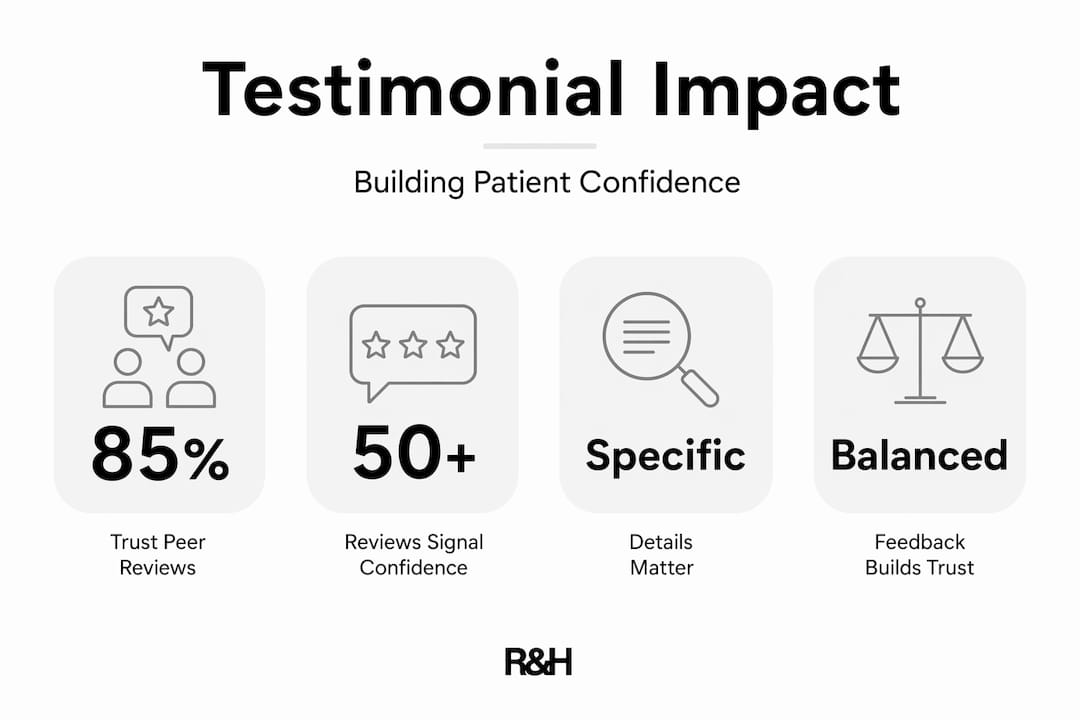
| Volume and recency are trust signals | Practices with over 50 recent reviews consistently build stronger patient confidence than those with fewer. |
| Look beyond star ratings | Read for specificity, emotional context, and honest problem-resolution stories rather than just scores. |
| Pair testimonials with other trust signals | Combine patient stories with evidence of clinical credentials, transparent pricing, and written guarantees. |
Why dental testimonials act as social proof
The concept of social proof is straightforward: when we are uncertain, we look to the experience of others. In healthcare, this instinct is especially strong. Choosing a dentist is not like buying a book. The stakes involve physical discomfort, significant expense, and often a degree of vulnerability that most people find difficult to articulate.
Testimonials shift the burden of proof in a meaningful way. Rather than a practice telling you it is excellent, a patient with no commercial stake in the matter tells you what actually happened. Patients trust peer stories significantly more than polished advertisements, and this holds true across all age groups and nationalities. For English-speaking expats in Marbella who may not have an established network of local recommendations, this effect is amplified considerably.
“Reading the testimonials on the clinic’s website made me feel like I already knew what to expect. It wasn’t what the dentist said that convinced me. It was what the previous patients said.”
This kind of sentiment surfaces repeatedly in patient feedback, and it points to something important. Testimonials address the unspoken barriers to treatment, such as fear of pain, anxiety about communication in a foreign language, and concern about appointment efficiency, more directly than any clinical statement can. Dental implant testimonials have been shown to increase conversion rates by up to 30%, precisely because they speak to these emotional concerns with credibility that clinical language rarely achieves.
Types of testimonials and what makes them effective
Not all dental testimonials carry equal weight. Understanding which formats and which content themes are most genuinely useful helps you extract real value from what you read or watch.
Written testimonials offer detail and context. The most effective ones are specific: they name the treatment, describe the patient’s starting concern, explain what the experience was like, and reflect on the outcome. A testimonial that reads “very professional, highly recommend” tells you almost nothing. One that describes a patient’s initial fear of dental procedures, their experience of being heard by the clinical team, the outcome of their implant treatment, and how it changed their confidence is genuinely informative.
Video testimonials add a dimension that text cannot replicate. Video testimonials increase engagement by up to 50% and boost conversion rates by as much as 40%, not because they look impressive, but because you can read body language, hear tone of voice, and sense genuine emotion. A patient who pauses while talking about their restored smile conveys something authentic that no written summary can quite capture.
The most effective testimonial themes tend to fall into a few recognisable patterns:
- Life-changing stories: Patients who had avoided dentistry for years due to anxiety and describe how their experience changed that pattern entirely
- Problem-solution narratives: Clear accounts of a specific dental problem, the treatment path taken, and a measurable improvement in function or appearance
- Expertise recognition: Patients who had previously received unsatisfactory treatment elsewhere and who can contrast that with the quality and care they experienced at their new practice
- Before-and-after transformations: Particularly powerful for aesthetic treatments, where patients describe both the visible treatment results and the emotional impact of the change
One element that many patients overlook is the value of professionally handled negative feedback. Consumers are 85% more likely to trust a practice that has a mix of positive reviews and honestly addressed concerns than one with a suspiciously uniform catalogue of five-star praise. A practice that responds thoughtfully to a critical review demonstrates accountability. That is a meaningful signal.
Pro Tip: When reading written testimonials, look for sentences that describe how the patient felt during treatment, not just afterwards. Emotional honesty mid-process is the hardest thing to fabricate.

How testimonials shape the patient decision journey
Understanding the role of testimonials across the full arc of how patients choose a dentist reveals just how significant the impact of dental reviews genuinely is.
- Initial research phase: Most patients begin by searching for a dental practice online. At this stage, testimonials are often the first substantive content that feels personal and credible. Patients in 2026 expect educational content, real examples, and transparent information before they are willing to take any action.
- Shortlisting phase: When comparing two or three practices, testimonials become a differentiator. A practice with 15 reviews and a practice with 80 reviews may have similar average ratings, but practices with over 50 reviews consistently attract more new patients, because volume itself signals established trust.
- Pre-consultation phase: Specific testimonials about staff warmth, communication quality, and appointment efficiency address concerns that patients value most before they even meet a clinician. These micro-trust signals reduce anxiety and increase the likelihood of following through with a booking.
- Post-consultation reinforcement: Even after meeting a dentist, patients return to testimonials to reassure themselves they have made the right choice. Reviews from patients who had similar treatments to the one proposed become especially relevant at this stage.
The table below illustrates how testimonial characteristics interact with patient confidence:
| Testimonial characteristic | Effect on patient confidence |
|---|---|
| High volume (50+ reviews) | Signals established credibility and consistent experience |
| Recent reviews (within 6 months) | Confirms the practice maintains current standards |
| Treatment-specific detail | Directly addresses the patient’s own treatment concern |
| Emotional narrative included | Reduces anxiety by normalising the patient experience |
| Professionally handled criticism | Demonstrates accountability and commitment to care |
Assessing dental testimonials when choosing in Marbella
Reading testimonials well is a skill. Here is how to approach them with the discernment they deserve.
Look past the star rating. A 4.8 average score tells you very little by itself. The narrative content is where the real information lives. Ask yourself: does this review describe a situation similar to mine? Does the patient mention the treatment I am considering? Is there any indication of how concerns were handled when things were not straightforward?
Use multiple platforms. A practice’s own website curates its best material, which is entirely reasonable. Cross-reference with Google reviews, independent forums, and expat community groups. The reputation management practices of a clinic across multiple platforms reflect a genuine commitment to patient feedback rather than a selective presentation of highlights.
| Testimonial source | Strengths | Limitations |
|---|---|---|
| Clinic website | Detailed, often with photos or video | Curated by the practice |
| Google reviews | Independent, high volume, searchable | Variable detail, some are very brief |
| Expat community groups | Contextually relevant, candid | Small sample, potentially dated |
| Video testimonials | Emotionally credible, harder to fabricate | May be produced with clinical guidance |
Beware uniformity. A collection of testimonials that all use similar language, avoid any mention of challenges, and follow the same cheerful arc should prompt a degree of scepticism. Authentic patient feedback has texture and variation. Some patients mention waiting times. Some describe initial nerves. Some reflect on the adjustment period after a procedure. That kind of honesty is a positive signal, not a negative one.
When reading testimonials about dental implant procedures in particular, look for patients who describe the full timeline, not just the finished result. Implant treatment spans several months. A testimonial that acknowledges that length honestly, while still reflecting positively on the care received, carries considerably more credibility than one that presents treatment as seamlessly effortless.
Pro Tip: Ask the clinic directly whether you can speak with a former patient who had a similar treatment to the one you are considering. Reputable practices are generally comfortable facilitating this, and the conversation will tell you more than any written review.
Limitations of dental testimonials
Testimonials are genuinely useful, but they have limits that are worth understanding before you rely on them as your primary decision tool.
- They reflect individual experience, not clinical outcome data. A patient who loved their dentist may not be the most reliable judge of the technical quality of their crown preparation. Positive experience and clinical excellence often coincide, but they are not identical.
- Recency matters more than you might expect. A practice that collected 40 glowing reviews three years ago may have experienced staff changes, ownership transitions, or shifts in service quality since then. Filter by date as standard practice.
- Testimonials cannot replace a consultation. No amount of reading other patients’ stories will tell you whether a proposed treatment plan is right for your specific anatomy, dental history, and clinical situation. Testimonials build informed confidence. A consultation builds personalised understanding.
- Some concerns require direct conversation. If a theme recurs in critical reviews, such as communication difficulties or unexpected costs, raise it directly with the practice rather than letting it become a silent barrier to care.
Combining testimonials with visible clinical credentials, transparent pricing, and written treatment guarantees creates a far stronger basis for confidence than testimonials alone.
My perspective: what testimonials really show you
I have worked with expat patients in Marbella for long enough to notice a consistent pattern. The patients who arrive most prepared, most calm, and most realistic about their treatment are almost always those who did their reading. And a significant part of what they read was patient testimonials.
What strikes me most is that the testimonials patients find most reassuring are rarely the ones that describe perfect outcomes with no complications. They are the ones where a patient describes having a concern, raising it with the clinical team, and being taken seriously. That interaction tells a prospective patient far more about a practice’s culture than any list of qualifications.
I have also seen patients arrive with entirely unrealistic expectations because they fixated on one exceptional before-and-after story without reading the broader range of patient experiences. Testimonials are most valuable when you read them as a collection, not as individual advertisements for a dream outcome. The pattern across many real patient voices is where the truth sits.
At R&H Dental, patient feedback is not something we file away. It shapes how we approach communication, how we explain treatment timelines, and how we handle the moments when a patient has a concern mid-treatment. The relationship between honest patient feedback and clinical improvement is direct. That is why testimonials matter, not because they are good marketing, but because they are honest mirrors.
Choosing with confidence at R&H Dental
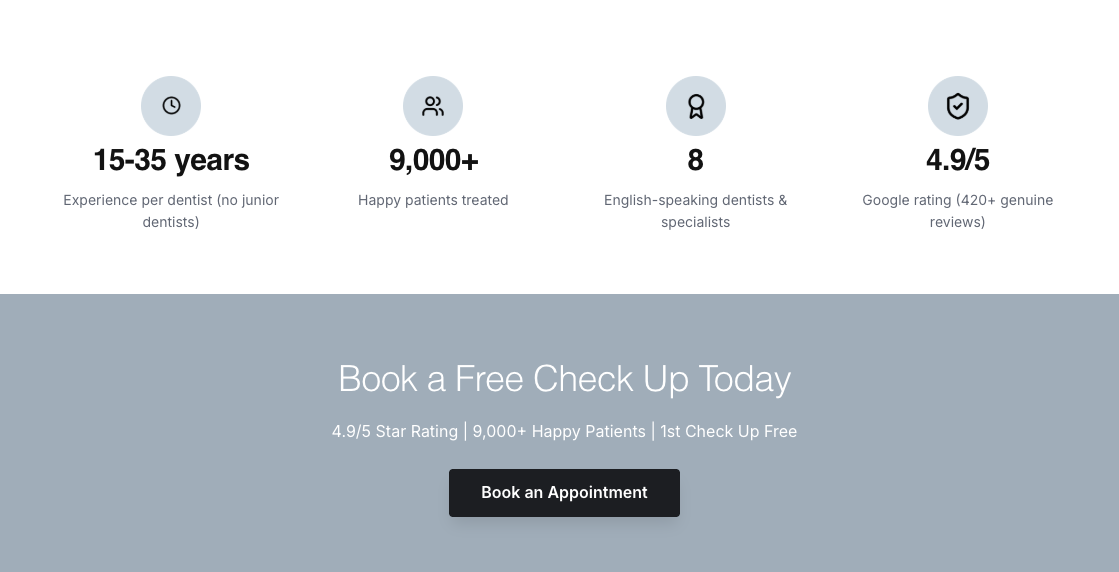
At Rhdentalmarbella, our patient testimonials reflect something we consider fundamental: dental care that combines clinical precision with genuine human attentiveness. Our team of English-speaking dentists, each with 15 to 35 years of experience from Finland, New Zealand, Ireland, Portugal, and Spain, brings both the technical expertise and the patient communication skills that genuine testimonials describe so well. We offer transparent pricing with no hidden costs, a written guarantee policy, in-house 3D CBCT diagnostics, and an in-house digital laboratory. You can explore our facilities through a virtual clinic tour before you even arrive. When you are ready to understand what treatment might look like for your own situation, we welcome you to book a consultation at a pace that suits you.
FAQ
Why do dental testimonials matter more than advertisements?
Testimonials come from patients with no commercial interest in the outcome, which is why they build trust in a way that practice advertising cannot replicate. Peer stories address emotional concerns, such as fear and uncertainty, directly and credibly.
How many dental reviews should a clinic have to be trustworthy?
Practices with over 50 reviews consistently attract more patient confidence than those with fewer, even when average ratings are similar. Volume signals a sustained pattern of patient satisfaction, not a handful of exceptional experiences.
Are video testimonials more reliable than written ones?
Video testimonials are harder to fabricate because body language and tone convey authentic emotion that text cannot easily replicate. They are particularly credible when patients describe the full treatment process rather than only the final result.
Should I trust a clinic with only perfect reviews?
A mix of positive feedback and professionally addressed concerns is generally a stronger trust signal than an unblemished record. Patients are significantly more likely to trust a practice that demonstrates accountability alongside consistent excellence.
Can dental testimonials replace a consultation?
No. Testimonials build informed confidence and help you shortlist the right practice, but a personal consultation is where your specific clinical needs are assessed. Read testimonials to choose wisely, then attend a consultation to plan precisely.